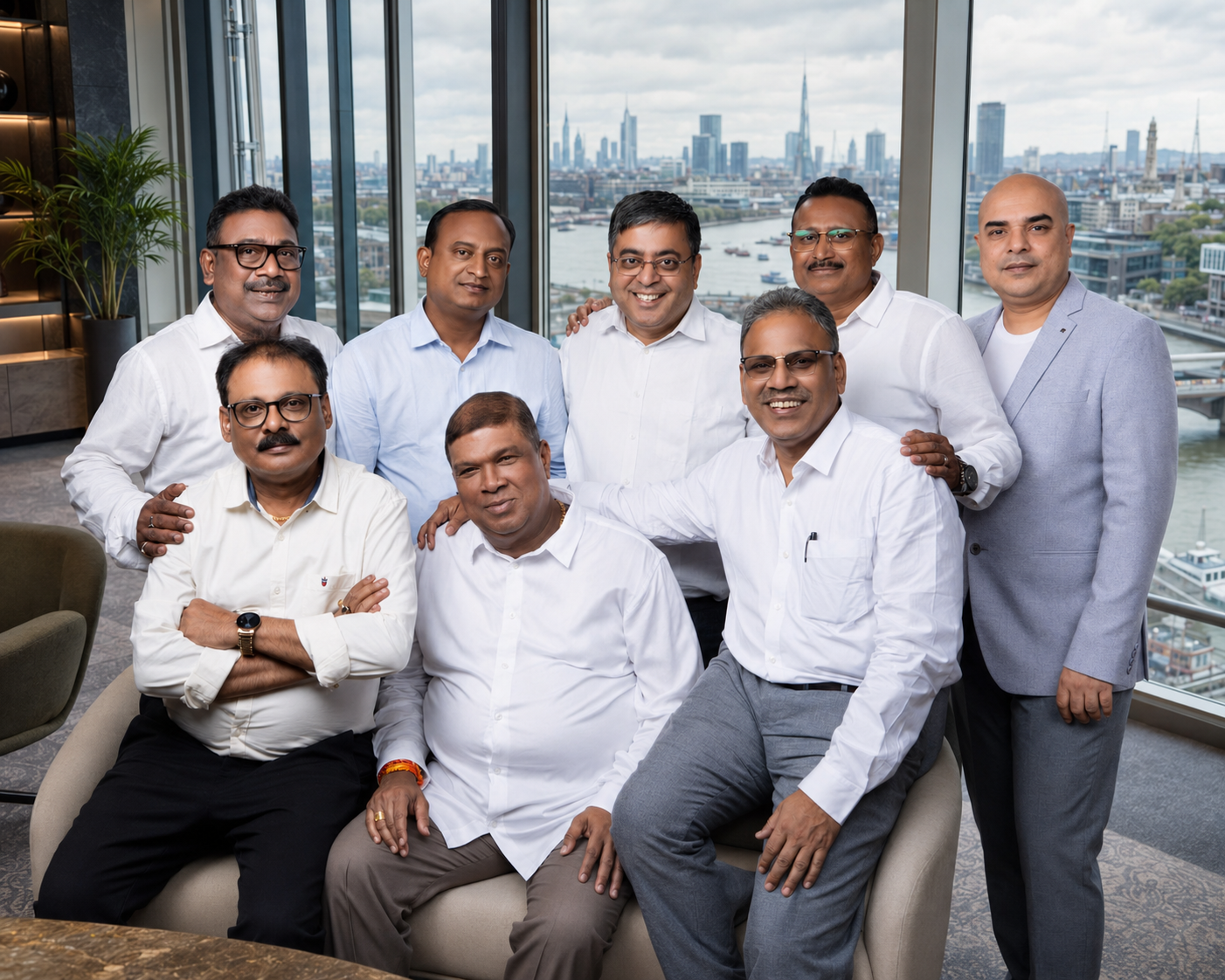
Raja Mukherjee’s vision statement, supported by The Confluence Group LLP and Evara Ekam LLP, places India’s 2047 ambition inside a wider debate on London, global fiscal hubs, the rupee, diaspora capital, AI-led Vedic education, affordable healthcare infrastructure, capital markets, private banking reform and measurable national execution.
Brilliant Bengalis Break Barriers of Sovereign Jurisdictions
The Confluence Group LLP, represented by Prashanta Mitra, Krishnendu Das, Arunangshu Das and Kaushik Sarkar, and Evara Ekam LLP, represented by Bidhan Chandra Roy, Jayanta Karmakar and Nilratan Naskar, are working as knowledge and execution partners around these initiatives. Within this structure, Bidhan Chandra Roy and Prashanta Mitra are being positioned as initiating forces behind knowledge-engineering hubs, Vedic holistic education and livelihood pathways, with a focus on youth skilling, international-level convergence and the larger ambition of building a self-reliant Bharat. The wider team’s role is to help translate Raja Mukherjee’s vision into institutional ideas that can connect knowledge, healthcare, livelihood, capital and governance with India’s long-term 2047 transformation.
Across the various attributes of the initiative, the team’s work is being connected to two major institutional ambitions: building Asia’s Knowledge Hub of Excellence and developing a world-class integrated 10,000-bed affordable healthcare city, targeted for 2029. The objective is to present these projects as part of a broader implementation architecture for knowledge engineering, healthcare access, Vedic holistic education, livelihood creation, youth empowerment and national self-reliance.
The proposed direction is ambitious: a Bengal-led knowledge and execution ecosystem that can work across sovereign jurisdictions, global fiscal hubs and institutional corridors such as Zurich, London, Paris, New York, Shanghai and Hong Kong, while still anchoring its purpose in India’s 2047 transformation. The phrase “Brilliant Bengalis Break Barriers of Sovereign Jurisdictions” therefore works as more than a subheading; it captures the human and institutional confidence behind the project.
India’s Global Policy Question
India’s ambition to become a developed nation by 2047 is no longer only a domestic policy story. It is becoming a global capital, governance and institutional credibility question. For decades, India’s rise was described through population scale, software talent, services exports, domestic consumption, diaspora success and geopolitical balance. Those remain important, but they no longer fully explain the next phase.
A developed India will be measured by the quality of institutions it builds, the currency confidence it earns, the capital it attracts, the talent it retains, the healthcare systems it scales and the discipline with which it converts long-term ambition into measurable execution. That is the larger frame of Raja Mukherjee’s Vision Statement. The document does not treat Viksit Bharat 2047 as a slogan. It treats it as an operating system.
For National Herald UK readers, this matters because Britain has long been tied to India’s financial, educational and diaspora networks. London remains a global centre for law, asset management, private banking, arbitration, higher education, capital markets and international structuring. If India’s next transformation succeeds, Britain may need to engage India not simply as a growth market or talent source, but as an emerging institutional power with its own financial architecture.
Five Pillars of Viksit Bharat 2047
| Pillar | Core Theme | 2047 Target | Lead Indicator |
| Vedic + AI Education | Gurukul-AI campuses, LLM tutors, robotics and neural-network learning | 10 million students; model exported to 25 nations | Learning-outcome index >= 0.85 |
| Medical & Engineering EduTech | Teaching hospitals, medical tourism and deep-tech labs | USD 50 billion cumulative FDI; 200 tertiary hospitals; 1,000 labs | PISA-equivalent rank Top 10 |
| FDI & Industrial Capacity | Long-horizon capital, manufacturing and deep-tech corridors | USD 200 billion annual FDI; USD 30 trillion GDP | Manufacturing at 25% of GDP |
| Stock Market as Price-Setter | Deep markets, wider listings and 24×7 INR-denominated trading | USD 40 trillion market cap; 350 million demat accounts | Global benchmark weight >= 12% |
| Rupee & Banking Reform | INR global trading, private banking and outbound capital liberalisation | INR in top-five reserve currencies; global INR trading hubs | INR share of SWIFT >= 6% |
Source: Raja Mukherjee Vision Statement, 2026.
Asia’s Knowledge Hub of Excellence and Affordable Healthcare City
One of the article’s central institutional ambitions is the team’s proposed work toward building Asia’s Knowledge Hub of Excellence and a world-class integrated 10,000-bed affordable healthcare city, targeted for 2029. This is framed as a vision-led and project-planning target within the larger 2047 framework, rather than as an already completed institution.
The idea connects three layers that are often separated in public-policy writing: knowledge engineering, healthcare access and livelihood generation. A healthcare city at this scale would not only be a hospital cluster. If designed properly, it could combine teaching hospitals, nursing and paramedical training, medical research, affordable treatment, digital health systems, youth skilling, livelihood creation and international patient corridors.
The knowledge hub component is equally important. It links Vedic holistic education with contemporary technology adaptation, AI-enabled learning, engineering capability and international convergence. In editorial terms, this gives the vision a sharper human-capital dimension: the objective is not only to attract capital, but to produce skilled citizens capable of building, managing and exporting new systems.
Knowledge and Healthcare Delivery Model
| Element | Purpose | Expected Strategic Role |
| Knowledge Engineering Hubs | Build applied learning and project-design capacity | Create skill pathways for youth and professionals |
| Vedic Holistic Education | Blend civilisational learning with technology and ethics | Support character-led, future-ready education |
| 10,000-Bed Affordable Healthcare City | Scale accessible tertiary care and medical training | Build regional healthcare capacity by 2029 target |
| Livelihood and Skilling | Connect education to employability | Enable self-reliant Bharat through practical skills |
| International Convergence | Connect India with global fiscal and knowledge hubs | Support cross-border institutional partnerships |
Source: Raja Mukherjee Vision Statement, 2026.
From Civilisational Confidence to Institutional Execution
The vision begins from a civilisational premise: India does not need to import a future; it needs to recover one. That line is not merely cultural. It is economic. For much of the modern period, Indian institutions were assessed against Western benchmarks. Mukherjee’s argument is that India must build at global standard without becoming derivative.
This is particularly visible in the education pillar. A student in a Gurukul-AI system is imagined as someone who can learn Vedic mathematics and modern algorithms, Sanskrit and artificial intelligence, ethics and robotics, Indian knowledge systems and frontier science. The Confluence Group LLP and Evara Ekam LLP become relevant here because they add the practical institutional layer needed to move from philosophical vision to operational design.
KPI and Governance Measurement Layers
| KPI Layer | What It Measures | Example Indicators |
| Outcome KPIs | Citizen-level results | Learning outcomes, lifespan, jobs, investor returns, rupee acceptance |
| Output KPIs | Institutions and capacity built | Hospitals, campuses, labs, listings, INR clearing hubs |
| Process KPIs | Policy and execution progress | Notifications, FDI approvals, licences issued, regulatory sandboxes |
| Governance KPIs | Trust and accountability | Audit, transparency, independent scorecards, public reporting |
Source: Raja Mukherjee Vision Statement, 2026.
2026-2047 Roadmap Snapshot
| Phase | Period | Strategic Focus | Key Milestones |
| Foundation | 2026-2030 | Policy notification, pilots and market plumbing | Gurukul-AI pilots, INR clearing desks, GIFT City scale-up, early healthcare-city planning |
| Acceleration | 2031-2035 | Scaling education, healthcare, FDI and rupee systems | Bharat Vidya export, deep-tech labs, phased capital-account opening, institutional hospital scale |
| Integration | 2036-2040 | Global currency links and market leadership | INR-oil settlement possibilities, reserve-currency recognition pathway, larger Indian market-cap base |
| Leadership | 2041-2047 | Global export and consolidation | 10 million Gurukul-AI students, 200 hospitals, USD 40 trillion market-cap ambition, top-five reserve-currency aspiration |
Source: Raja Mukherjee Vision Statement, 2026.
Why London and Global Fiscal Hubs Matter
London has a unique place in this debate. The UK remains a centre of global legal structuring, dispute resolution, asset management, private banking, insurance, education and international capital. Indian-origin wealth has long used London for property, advisory, family-office access, global education and professional services.
Mukherjee’s vision does not remove London from India’s future. It changes London’s role. If GIFT City matures, if the rupee becomes more internationally usable, and if Indian private banking reform allows Indian families and corporates to operate globally from an Indian base, London’s role may shift from destination to partner. The same applies to Zurich, Paris, New York, Shanghai and Hong Kong, where the Indian rupee may eventually seek a fuller international trading operation.
This is the UK-facing heart of the article. The future should not be framed as London versus India. It should be framed as London with India, provided British institutions understand that India is building its own financial and institutional centre of gravity.
The Rupee, Diaspora Capital and Dharma-Finance
No great-power development story is complete without a currency question. Mukherjee argues that the Indian rupee must become tradable, clearable and investable across major financial hubs. Such a transition cannot be declared overnight. It must be earned through inflation credibility, deep markets, legal certainty, reserve adequacy, payment infrastructure and global trust.
The vision also identifies the Indian diaspora as one of India’s most under-leveraged strategic assets. For the UK, this is not theoretical. Indian-origin professionals, physicians, academics, founders, financiers and investors form a major part of Britain’s economic and intellectual landscape. If structured well, the UK-India diaspora relationship could become an institutional development channel for India’s education, healthcare, deep-tech, private banking and capital-market ambitions. Within this architecture, The Confluence Group LLP and Evara Ekam LLP are projected as working hand in hand with the Indian diaspora to help bring FDI, knowledge networks and human capital back to Bharat. The team’s ambition is to channel Indian diaspora capability and human capital toward building a resurgent and powerful Bharat under the Vision of Viksit Bharat 2047, with Krishnendu Das, Arunangshu Das, Kaushik Sarkar and Nilratan Naskar at the helm of this effort.
One of the most distinctive ideas in the vision is Dharma-finance. The global investment world has spent years debating ESG, sustainability and impact investing. Mukherjee’s proposition is that India can offer its own ethical capital doctrine rooted in dharma, where capital is treated as a trust and deployed for productive, transparent and intergenerationally fair outcomes.
Risk, Discipline and the Role of the Press
A vision of this scale must be tested. Currency liberalisation can create volatility. Healthcare expansion can dilute quality if badly executed. AI-led education raises data and pedagogy questions. FDI requires policy certainty. Capital-market expansion requires governance depth. Private banking liberalisation requires stronger supervision.
The role of the press is therefore not to merely promote the vision. It must explain it, interrogate it, track it and hold it to measurement. This is why the National Herald UK version should remain a policy and capital analysis rather than a promotional profile.
India’s Global Question
India’s next two decades will not be judged only by growth rates. They will be judged by whether the country can build systems. Can India educate at scale without losing quality? Can it build hospitals and engineering labs with long-horizon capital? Can it make the rupee more globally trusted? Can it deepen capital markets enough to set prices? Can it convert diaspora influence into institutional development?
These are not only Indian questions. They are global questions. For Britain, they will shape the future of UK-India finance, education, healthcare, law, capital markets, diaspora relations and private wealth. Viksit Bharat 2047, in Raja Mukherjee’s vision, is not simply a national aspiration. It is a global capital, knowledge and governance question.
About the Research Perspective
This article draws from the Vision Statement of Raja Mukherjee, Executive Alumni of IIM Visakhapatnam, Independent Researcher, Geopolitical Analyst, Private Banker and Discretionary Portfolio Advisor. His work examines Viksit Bharat 2047, private banking, rupee internationalisation, Indian capital markets, diaspora capital, Gulf corridors, AI infrastructure and India’s emerging financial architecture.